player

Choosing a proprietary trading firm starts with a fundamental question: which markets do you actually want to trade? A futures specialist and a forex trader may both want access to simulated capital, performance-based rewards, and a structured evaluation, but the rules governing their accounts can be very different.
Topstep focuses on exchange-traded futures, while CFD prop firms generally offer instruments such as forex pairs, stock indices, metals, cryptocurrencies, and individual shares, depending on the provider. These differences influence everything from position sizing and drawdown calculations to trading hours and account progression.
Understanding the distinction before paying for a challenge can help you avoid choosing a program that conflicts with your strategy. This guide compares Topstep with five CFD prop firms, examining their trading instruments, risk parameters, evaluation structures, and potential advantages.
Topstep vs. CFD Prop Firms: A Quick Comparison
| Rank | Prop Firm | Main Markets | Key Advantage | Important Consideration |
|---|---|---|---|---|
| 1 | Topstep | Exchange-traded futures | Futures-focused evaluation and a structured funding pathway | Contract limits and futures-specific drawdown rules |
| 2 | FTMO | Forex and other CFDs | Established evaluation framework and clearly defined objectives | Challenge-specific risk and consistency rules |
| 3 | The5ers | Forex and other CFDs | Multiple evaluation pathways and progression options | Conditions differ between programs |
| 4 | Leofins | Forex, indices, metals, crypto, and shares through CFDs | Multiple challenge formats and static maximum-loss limits | Program-specific payout and risk conditions |
| 5 | FundedNext | Forex and other CFD markets, with additional product-specific offerings | Different evaluation models for different trading approaches | Each model has its own objectives and restrictions |
| 6 | FundingPips | Forex and other CFDs | Several challenge formats with different risk structures | Daily and overall loss limits depend on the selected model |
This comparison focuses on product fit and the practical differences between the firms. It is not a guarantee of profitability, and the ranking does not mean that the first option will suit every trader.
What Is the Difference Between Futures and CFDs?
Before comparing individual companies, it is useful to understand the instruments involved.
Futures: Standardized exchange-traded contracts
Futures are standardized contracts traded on organized exchanges. Depending on the contract, traders can gain exposure to equity indices, energy products, metals, agricultural commodities, and currency markets.
Every futures contract has defined specifications, including its contract size, tick size, tick value, and expiration arrangements. These details directly influence the amount of money gained or lost when the market moves.
For example, a trader using an equity-index futures contract must understand how many dollars each tick represents. Increasing the number of contracts increases the financial impact of each market movement.
Topstep is built around this environment. Its Trading Combine evaluates traders in a simulated setting, and successful participants may progress to an Express Funded Account. Eligible traders can potentially advance to a Live Funded Account under the firm’s applicable rules.
This makes Topstep particularly relevant to people who already understand futures contracts and want a program centered on this market.
CFDs: Flexible access to multiple markets
A contract for difference, or CFD, allows a trader to speculate on changes in an instrument’s price without directly owning the underlying asset.
Depending on the firm, a CFD account may provide access to currency pairs, indices, metals, energy products, cryptocurrencies, and shares. Traders can therefore use one platform to work with several asset classes.
CFD prop firms generally evaluate traders through simulated accounts. The evaluation may include profit targets, daily loss limits, maximum loss thresholds, minimum trading requirements, and consistency rules.
These parameters vary by company and challenge type. Two programs advertised with the same account balance may impose significantly different restrictions.
The key distinction is that futures programs typically express position limits through the number and type of contracts, while CFD challenges commonly use percentage-based loss limits alongside instrument-specific position-sizing rules.
1. Topstep: A Futures-First Funding Pathway
Topstep is the most natural option to investigate if your strategy revolves around exchange-traded futures rather than spot forex or CFDs.
Its Trading Combine is an evaluation program with defined profit objectives, a consistency requirement, and a Maximum Loss Limit. The available account tiers have different position limits. For example, the published Trading Combine parameters include maximum position sizes of five contracts for the $50,000 tier, ten for the $100,000 tier, and fifteen for the $150,000 tier, subject to the firm’s contract-counting rules.
Passing the evaluation does not mean that every subsequent account works identically. The Express Funded Account has its own requirements, and the Live Funded Account represents a further stage in the program.
How Topstep manages risk
One of the most important concepts is the Maximum Loss Limit. Rather than relying solely on a percentage-based daily loss rule, Topstep uses a futures-specific account risk framework.
The precise effect of a loss depends on the account’s balance, the applicable loss threshold, and the rules governing open positions. Traders need to understand how unrealized profit and loss affects their available room before entering a trade.
The scaling plan also matters. In an Express Funded Account, the maximum position size is linked to the account balance. A trader who withdraws profits should check whether the remaining balance changes the permitted contract allowance.
Who should consider Topstep?
Topstep is worth considering if you:
- Trade futures regularly and understand contract specifications.
- Prefer a program designed specifically for futures markets.
- Want a defined progression from evaluation toward funded trading.
- Are comfortable managing position limits and account-specific drawdown rules.
The main drawback is that futures-specific restrictions can feel unfamiliar to someone accustomed to CFD trading. A forex strategy cannot automatically be transferred to futures without accounting for contract values, liquidity, trading hours, and the firm’s rules.
2. FTMO: A Structured Alternative for CFD Traders
FTMO is a relevant alternative for traders who prefer forex and other CFD instruments. Its evaluation programs use defined profit targets and risk limits, with the exact requirements depending on the selected model.
For example, the published FTMO Challenge 1-Step includes a 10% profit target, a 3% maximum daily loss, and a 10% maximum-loss threshold. Its maximum-loss calculation uses a trailing reference based on the end-of-day balance. Other FTMO models have different requirements, so traders should not apply the same figures to every account.
Why the risk calculation matters
CFD traders need to understand how their daily and overall loss limits are calculated. Floating losses, commissions, swaps, and the timing of daily resets can all affect whether an account remains within its permitted thresholds.
A strategy that looks profitable in historical testing may still be unsuitable for a particular challenge if its normal drawdowns frequently approach the firm’s limits.
FTMO’s evaluation structure makes it important to plan the risk of each trade before entry and to monitor the account’s remaining loss allowance.
Who should consider FTMO?
FTMO may suit traders who want access to forex and other CFD markets through a structured evaluation. It can be particularly relevant to traders who already use percentage-based position sizing and are comfortable working with daily and maximum loss thresholds.
Its principal limitation is that the selected challenge model determines the rules. A trader must examine the actual objectives and consistency requirements rather than relying on the firm’s general reputation.
3. The5ers: Multiple CFD Evaluation Pathways
The5ers offers several trading programs, allowing traders to compare different evaluation structures and progression conditions.
Rather than assuming that one set of rules applies across the company, it is important to examine the particular program being considered. Profit targets, daily loss limits, maximum loss rules, scaling opportunities, and payout conditions can vary.
This is relevant when comparing The5ers with Topstep. A futures trader may focus on how many contracts can be traded at a particular account stage. A CFD trader needs to understand how percentage-based drawdown limits affect the size and frequency of trades.
What to evaluate
Before choosing a The5ers program, establish:
- How many evaluation stages are required.
- Whether a daily loss limit applies and how it is calculated.
- Whether the maximum loss is static or follows a different calculation.
- How progression and scaling work after qualification.
- When payouts become available and what conditions apply.
These factors determine whether the program matches your trading approach more reliably than the advertised account size alone.
Who should consider The5ers?
The5ers is worth investigating for CFD traders who want to compare different evaluation pathways and select a structure that fits their experience and risk management.
The potential drawback is the need to distinguish carefully between programs. The rules of one account should never be assumed to apply to another.
4. Leofins: Multiple CFD Challenges and Static Maximum Loss
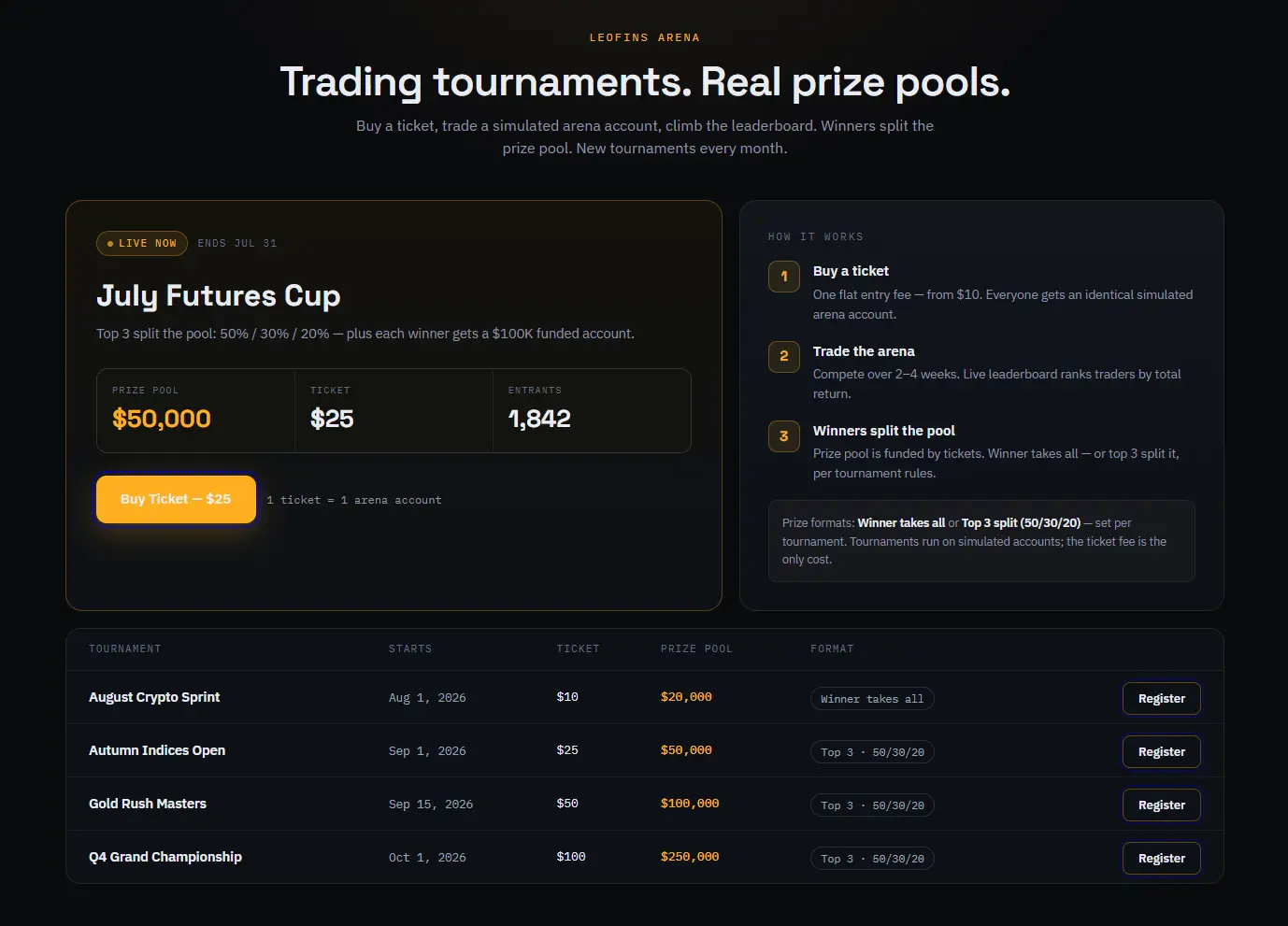 Leofins offers several CFD evaluation structures, giving traders a choice between different challenge formats and risk parameters.
You can review its programs at www.leofins.com/
The firm’s published challenge structures include Core 2-Step, Edge 1-Step, and Starter 3-Step. These programs use different combinations of profit targets, daily loss limits, and maximum-loss thresholds.
Comparing the Leofins challenge structures
Core 2-Step uses two evaluation phases with published profit targets of 7% and 4%. Its daily loss limit is 5%, while the maximum loss is 10% of the initial account balance.
Edge 1-Step uses a single evaluation phase with an 8% profit target. The daily loss limit is 4%, and the maximum loss is 7% of the initial balance.
Starter 3-Step uses three phases with targets of 6%, 4%, and 4%. The published daily loss limit is 4%, and the maximum loss is 8%.
These figures describe the published program structures and should be checked against the current terms before purchase.
Why static maximum loss can matter
A static maximum-loss threshold remains anchored to the initial account balance instead of rising as the account achieves new balance highs. This can make the overall loss boundary easier to identify when planning a strategy.
However, static maximum loss does not eliminate risk. The daily loss limit still applies, and traders must understand how the firm calculates the relevant daily reference and treats open positions.
For traders moving from futures to CFDs, the difference is particularly important. Topstep’s contract limits and Maximum Loss Limit require futures-specific planning. Leofins’ CFD challenges instead use percentage-based risk parameters, so the trader needs to adjust position size according to the instrument, stop distance, and applicable account rules.
Who should consider Leofins?
Leofins may be worth considering for CFD traders who want to compare one-stage, two-stage, and three-stage evaluations. The availability of different structures makes it possible to assess which combination of targets and loss limits is most compatible with a particular approach.
The potential drawback is that the evaluation structure alone does not tell the whole story. Traders must also review payout eligibility, trading restrictions, and the terms governing simulated performance-based rewards.
5. FundedNext: Several Evaluation Models
FundedNext offers multiple evaluation models, with different profit objectives and risk limits. This gives traders options, but it also makes the exact program selection important.
For example, its published CFD objectives distinguish between the Stellar 1-Step, Stellar 2-Step, and Stellar Lite programs. The daily and maximum loss parameters differ by model, so traders should not assume that one program’s risk rules apply across the entire product range.
Why challenge selection matters
Suppose a trader prefers to hold positions through normal market fluctuations. A challenge with a restrictive daily loss threshold may be a poor match even if its overall loss allowance looks reasonable.
Likewise, a model with a higher maximum loss allowance may have a different profit target, consistency condition, or payout requirement.
Before enrolling, compare the following:
- Profit targets and evaluation stages.
- Daily loss calculation and reset timing.
- Maximum loss method.
- Minimum trading-day requirements.
- Payout eligibility and reward conditions.
- Restrictions on trading strategies or holding positions.
Who should consider FundedNext?
FundedNext may suit CFD traders who want to compare several evaluation structures before choosing an account. Its different models can be useful for traders with different approaches, provided they understand the associated restrictions.
The main drawback is the possibility of focusing on one attractive rule while overlooking another that has a greater effect on the strategy.
6. FundingPips: Different Risk Structures Under One Brand
FundingPips provides multiple challenge models, with differences in daily loss limits, overall loss thresholds, and other program conditions.
Its published model comparisons show that risk parameters vary depending on the chosen challenge. Some structures use static maximum-loss limits, while others use different arrangements. This means that the name of the firm alone is not enough to determine whether a particular account is suitable.
What traders should examine
The most important step is to identify the exact model and read its current rules. Pay particular attention to the relationship between daily and overall loss limits.
A trader who normally experiences large intraday fluctuations may need a different structure from someone who uses tight stops and short holding periods. News restrictions, overnight positions, weekend holding, and consistency requirements may also influence whether the program is appropriate.
Who should consider FundingPips?
FundingPips is worth comparing for traders who want to evaluate different CFD challenge formats. However, the best choice depends on the actual terms rather than the number of available account options.
Before paying, establish the applicable drawdown calculation, target, payout rules, and restrictions for the specific model.
Futures vs. CFDs: Comparing Risk Properly
One of the most common mistakes is comparing two prop firms solely by their advertised account balances.
Imagine that two firms each offer a simulated account displaying $50,000. One allows a maximum of five futures contracts during evaluation, while the other sets daily losses as a percentage of the account’s reference balance.
Those numbers do not describe equivalent exposure.
With futures, risk depends on the contract being traded, the number of contracts, tick value, market movement, and the distance to the planned exit. The maximum contract allowance is a position restriction, not a guarantee about how much money can be lost.
With CFDs, the trader needs to understand the loss thresholds, how floating profit and loss is treated, and how the daily reference is calculated. Position size must be adjusted so that normal adverse price movements do not put the account at risk of breaching the firm’s rules.
In either environment, a breach can result in the loss of access to the account. A larger advertised balance does not remove that possibility.
Which Type of Prop Firm Fits Your Trading Style?
Choose a futures program if you specialize in exchange-traded contracts
If your strategy is built around futures, Topstep is the most directly relevant option in this comparison. Focus on the available contracts, tick values, position limits, Maximum Loss Limit, scaling plan, and progression requirements.
Do not assume that a futures contract and a similarly named CFD have identical trading characteristics. Contract specifications and risk calculations can differ substantially.
Choose a CFD program if you trade forex or several asset classes
FTMO, The5ers, Leofins, FundedNext, and FundingPips are more relevant to traders who want access to forex and other CFDs offered by these providers.
Compare the available instruments, platform support, daily loss rules, maximum loss method, evaluation structure, and payout requirements. If you use automated trading, hold positions overnight, or trade around economic announcements, confirm the applicable restrictions before enrolling.
Compare the full program rather than its headline account size
A larger account is not necessarily better if its loss limits are incompatible with your strategy. Likewise, a lower entry fee may offer poor value if the evaluation conditions are unrealistic for your trading approach.
The more useful comparison is between the risk you can reasonably take and the restrictions imposed by the program.
Frequently Asked Questions
Is Topstep a CFD prop firm?
No. Topstep is a futures-focused proprietary trading firm. Its core evaluation and funding pathways are based on exchange-traded futures rather than the broad CFD instrument sets offered by firms such as FTMO and Leofins.
Can I trade forex with Topstep?
Topstep’s core program focuses on futures. Currency futures are exchange-traded contracts and are not the same as spot forex or forex CFDs. Check the current list of supported contracts to establish which currency-related products are available.
Are prop firm accounts real or simulated?
Many proprietary trading evaluations use simulated accounts. Topstep has a simulated evaluation stage and an Express Funded Account, with eligible traders potentially progressing to a Live Funded Account. CFD firms also commonly use simulated accounts with performance-based reward arrangements. The exact structure and eligibility requirements depend on the provider.
Which is easier: futures or CFD prop trading?
Neither is inherently easier. A futures specialist may be more comfortable with contract-based rules, while a forex trader may prefer CFD instruments and percentage-based loss limits. Difficulty depends on the strategy, experience, market knowledge, and ability to comply with the rules.
Are futures and CFD account balances directly comparable?
No. The displayed balance does not establish equivalent risk or buying power. Compare contract limits, loss thresholds, instrument specifications, position sizing, and payout conditions before making a decision.
What should I check before purchasing a challenge?
Review the current fee, profit target, daily loss limit, maximum loss method, minimum trading requirements, permitted instruments, payout eligibility, position restrictions, and prohibited strategies. Make sure you are reading the terms for the exact account you intend to purchase.
Making the Right Choice
Topstep and CFD prop firms serve different trading needs. Topstep is built around futures contracts, contract-based position limits, and a staged progression toward funded trading. CFD firms provide access to different instruments and commonly use percentage-based loss limits within their evaluation structures.
For a futures specialist, Topstep may be the most natural place to begin comparing programs. For traders focused on forex, indices, metals, or other CFD markets, FTMO, The5ers, Leofins, FundedNext, and FundingPips offer alternatives worth examining.
The right choice is the one whose rules match your trading method. Before committing money to an evaluation, understand how losses are calculated, what happens when a limit is breached, and which conditions govern payouts. A program should support disciplined risk management rather than encourage you to take larger risks simply to reach a target.
Prices and conditions are current as of October 2026.
Risk disclaimer: Proprietary trading evaluations involve financial risk. Challenge fees may be lost if an evaluation is unsuccessful or program rules are breached. Simulated trading and funded-program results do not guarantee future performance or income. Review the current terms carefully and never spend money you cannot afford to lose.